

At AUA2026, urology’s direction felt increasingly clear: more precise, less invasive, and more patient centered.
Across oncology, stone disease, BPH, and incontinence care, many of this year’s updates reflected a specialty refining existing therapies, advancing new procedural models, and reducing treatment burden without compromising outcomes.
From bladder-sparing oncology strategies to minimally invasive office-based care, urology continues moving toward treatment approaches shaped not only by clinical efficacy, but also by recovery time, long-term function, and patient quality of life. At the same time, workforce shortages and uneven access to care remain ongoing challenges.
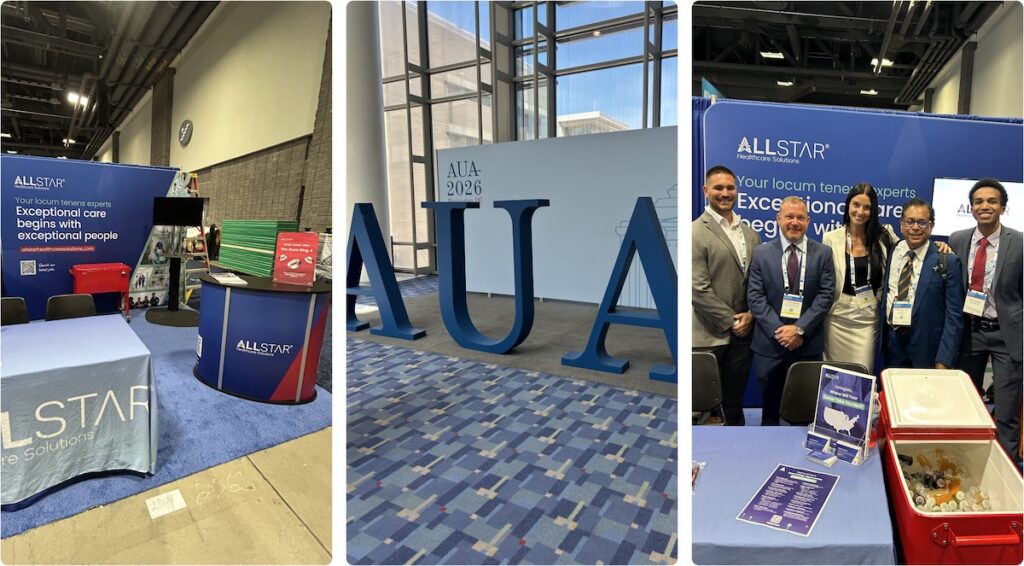
Throughout the conference, the All Star Healthcare Solutions team spoke with urologists nationwide about the clinical, operational, and workforce realities shaping modern urology practice — while also following the latest research and technology updates firsthand.
Here are some of the trials, technologies, and broader trends that stood out most at this year’s meeting.
Top Takeaways at a Glance
- Urologic oncology continues moving toward more combination therapies, selective treatment intensification, and bladder-sparing strategies.
- Benign urology is increasingly focused on minimally invasive, office-based, and durable therapies that reduce recovery burden while preserving symptom relief.
- Quality-of-life and patient-reported outcomes are playing a larger role in defining treatment success, particularly in BPH and incontinence care.
- The future of urology may be defined less by how aggressively clinicians intervene and more by how precisely they match the right treatment to the right patient.
- Workforce shortages and uneven provider distribution continue shaping how and where urologic care is delivered across the country.
Bladder Cancer Care Continues Moving Toward Bladder Preservation
Several of the most closely watched oncology updates at AUA2026 focused not just on controlling disease, but on delaying or avoiding cystectomy altogether in carefully selected patients.
Expanded analyses from the POTOMAC trial supported durvalumab plus BCG in BCG-naïve high-risk non-muscle-invasive bladder cancer, showing improved recurrence-free outcomes compared with BCG alone. The findings reinforce growing interest in combination approaches for patients at elevated risk of recurrence.
Meanwhile, interim phase 2 LEGEND data showed promising complete response rates with intravesical detalimogene voraplasmid in BCG-unresponsive non-muscle-invasive bladder cancer with carcinoma in situ, pointing toward another potential bladder-sparing pathway for patients with historically limited treatment options.
Additional pembrolizumab plus BCG findings in BCG-naïve very high-risk T1 NMIBC pushed that conversation even further. The phase 2 trial reported a 92% complete response rate at 6 months, with no muscle-invasive or metastatic progression observed during the 22-month median follow-up period.
Taken together, the updates reflected a continued shift toward preserving bladder function when appropriate — particularly for patients seeking alternatives to radical surgery.
Prostate Cancer Research Focused on Precision and Treatment Intensification
Prostate cancer updates at AUA2026 reflected a growing emphasis on identifying which patients truly benefit from more aggressive intervention — and where escalation may offer diminishing returns.
The phase 2 ARASEC study evaluated darolutamide plus androgen deprivation therapy in metastatic hormone-sensitive prostate cancer using an external historical control design. The study showed improved progression-free survival, overall survival, and PSA response rates compared with ADT alone, supporting continued interest in treatment intensification strategies for appropriately selected patients.
Meanwhile, long-term follow-up data evaluating extended versus limited pelvic lymph node dissection during radical prostatectomy for intermediate- and high-risk prostate cancer offered a more nuanced picture. While extended pelvic lymph node dissection improved pathologic staging, it did not improve outcomes overall. However, investigators reported a possible biochemical recurrence-free survival benefit among patients with ISUP grade 3–5 disease, suggesting there may still be subgroups where a more extensive surgical approach provides meaningful value.
Additional phase 3 results for CAN-2409 in localized prostate cancer showed improved disease-free survival compared with placebo, along with lower rates of biochemical recurrence, salvage therapy, and metastasis. The strongest benefit appeared in intermediate-risk patients, supporting continued interest in aglatimagene besadenovec as an adjunct to standard radiation therapy.
Rather than moving uniformly toward “more treatment,” many of these studies pointed toward a more tailored approach: intensify therapy where the data support it, while avoiding unnecessary escalation where benefit remains uncertain.
Benign Urology Is Becoming Less Invasive — Without Sacrificing Durability
Some of the most noticeable momentum at AUA2026 came from therapies designed to reduce procedural burden while still delivering meaningful, lasting symptom improvement.
In stone disease, the SOUND pivotal trial met both co-primary endpoints for safety and effectiveness, supporting noninvasive, anesthesia-free lithotripsy as a viable office-based treatment option. If adopted more broadly, technologies like this could significantly change the patient experience surrounding stone management.
At the same time, the PUSH trial offered an important reminder that not every intervention produces the desired downstream outcomes. While the behavioral hydration program modestly increased urine volume in patients undergoing secondary stone prevention, it did not reduce recurrent stone events.
In BPH care, minimally invasive therapies continued showing encouraging durability data. The temporary Urocross implant evaluated in Expander-2 demonstrated sustained lower urinary tract symptom improvement through 24 months after removal, while three-year Zenflow data showed continued reductions in IPSS following treatment.
Urgency urinary incontinence research also reflected the specialty’s growing interest in lower-burden therapies. The INTIBIA trial — the first sham-controlled, double-blind pivotal study of an implantable tibial nerve stimulation device — showed significantly greater symptom improvement than sham treatment at three months, with durable benefit maintained through 12 months.
Across these studies, a broader trend emerged: many patients increasingly want treatments that minimize downtime, preserve quality of life, and fit more realistically into everyday life without sacrificing effectiveness.
Innovation Continues Expanding — Even as Access Challenges Persist
While AUA2026 highlighted increasingly sophisticated therapies and technologies, the meeting also underscored a much more basic challenge: many patients still struggle to access urologic care at all.
According to the 2025 AUA Census, approximately 62% of U.S. counties have no practicing urologist, while roughly 90% of urologists continue practicing in metropolitan or urban areas. The workforce also skews older, with a median practitioner age of 54, reinforcing concerns about long-term pipeline stability and geographic access disparities.
The contrast was difficult to ignore. Even as the specialty advances technologically, many communities continue facing long travel distances, delayed appointments, limited specialist availability, and mounting provider burnout.
Telehealth expansion, satellite clinics, and rural loan repayment initiatives may help improve access in some regions, but long-term workforce solutions will likely remain critical to the future of urologic care delivery.
Why More Urologists Are Exploring Locum Tenens
As new technologies, treatment pathways, and care models continue evolving across urology, the demand for flexible physician coverage is growing alongside them.
Locum tenens urologists are uniquely positioned to experience the changing realities of urologic practice while helping address critical coverage gaps in communities that need it most.
With assignments across healthcare systems nationwide, locum physicians can support continuity of care, expand patient access, and bring specialized expertise to areas that may otherwise lack local urologic services. Many roles also offer exposure to new clinical environments, diverse patient populations, and evolving procedural and practice models — allowing physicians to broaden their experience while adapting to different approaches to urologic care.
At All Star Healthcare Solutions, our specialized urology consultants help physicians find locum opportunities aligned with their clinical interests, career goals, and preferred practice settings. Whether you’re looking to expand your experience, explore new practice environments, or gain more flexibility in your schedule, our team can help connect you with assignments nationwide. Explore our Urologist Salary Guide to benchmark compensation and market trends and browse All Star’s open urology opportunities to find assignments that fit your schedule and expertise.